


What Are Dental Implants and How Do Dental Implants Work?
Dental implants are fabricated screws made of precious metal that are surgically placed into the jawbone below the gums where there are missing teeth.
Once in place, they allow your dentist to mount replacement teeth onto them, either as a single crown or a dental bridge.
Your new tooth will look and feel similar to your real teeth. Dental implants work like a natural teeth, giving you the ability to eat in a more natural way than other options.
Unlike other tooth-replacement methods, dental implant surgery also helps prevent the jawbone from deteriorating, as they not only replace your missing teeth, but restore the missing roots of a teeth, as well. The dental implant process comprises only a few steps and will have your smile looking and feeling better in no time.
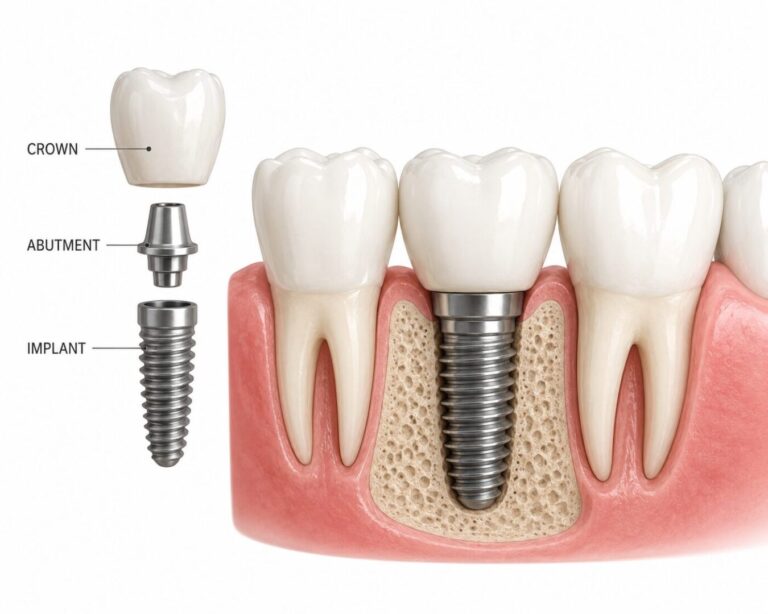
Dental Implant Options
Dental implants come in different sizes, heights and types. Dental implant surgery is performed with two main types of implants: endosteal and subperiosteal. Endosteal implants are placed in the jawbone and are the most commonly used type of implant. Subperiosteal implants are placed under the gum but above the jawbone. This type is often used in patients who do not have enough healthy natural jawbone. Dental implant options can be discussed with our dental implant dentists at the time of your visit.
Who Needs Dental Implants?
- To replace one or more missing teeth without affecting adjacent teeth.
- To resolve joint pain or bite problems caused by teeth shifting into a missing tooth space.
- To restore a patient’s confident smile.
- To resolve chewing, speech and digestion problems.
- To restore or enhance facial tissues.
- To support a bridge or denture making it more secure and comfortable.
Dental Implants Procedure
- An initial evaluation to determine the correct approach for your treatment.
- Tooth extraction, if you still have the tooth that needs to be replaced.
- Surgically inserting the dental implant to act as a stabilizer for the new tooth.
- Placing the abutment once your gum has healed, to act as a temporary tooth.
- Adding the permanent crown to act as a permanent tooth.
Post Treatment: What to Do After a Dental Implant
It’s natural to have some discomfort after the dental implant surgery. You may notice some bruising on your gums, swelling around your gums and face, some minor bleeding and some pain at the implant site. You should stock up on some soft foods after the surgery. You may also want to have some ice packs on hand to help reduce any swelling. You must keep up good hygiene habits to protect this implant. That means flossing daily and brushing your teeth twice a day.
Getting Your Dental Implants at West Coast Dental
If a dental implant procedure is the solution that’s right for you, West Coast Dental will make it affordable with a choice of payment options. We also accept most dental insurance and offer a dental discount program for patients without insurance.
Frequently asked questions (FAQs)
Getting a dental implant is a surgical procedure, and everyone’s pain tolerance level is different. Therefore, what one person may perceive as pain is only a slight discomfort for another person. The consensus about pain and dental implants is that the majority of people feel discomfort, not pain.
When properly maintained with adequate brushing and flossing, the implant itself can last a lifetime, assuming the patient receives regular dental checkups twice a year.
Yes, dental implants are safe. They have been used safely and successfully for more than 50 years with patients who are in generally good oral and overall health. Dental implants are typically made of titanium, a metal that is bio-compatible with the human body, meaning implant failure is very rare.
A traditional dental implant generally has a post diameter of 3 to 6 mm. A mini dental implant post is typically half the size of a traditional one. They are sometimes used when a patient doesn’t have enough bone density to support a full-size implant. Mini dental implants are made with a titanium post with a ball on the end of it, and a socket with a rubber ring that attaches the post and the tooth.
Like regular implants used in dental implant procedures, mini dental implant posts are made of titanium.
Yes. However, the only way a dental specialist would remove an implant is if it has failed, been damaged or not worked properly.
Yes. Individual insurance plans do reimburse portions of the dental implant procedure, but it’s very minimal. Our insurance specialists can help you determine your coverage and options.
Yes. Some alternatives to dental implants are fixed bridges and partial dentures.



